When it comes to high-performance engines, whether in a track car, a powerful motorcycle, or a high-revving classic, standard motor oil simply won’t cut it. These powerplants operate under extreme stress, generating intense heat and demanding superior lubrication to prevent wear and maintain peak power output. The right 10W-50 or 20W-50 racing oil is engineered to withstand these punishing conditions, providing a robust film strength that protects critical components under high loads and temperatures.
Selecting the correct oil is a critical decision that directly impacts engine longevity and performance. This viscosity grade is ideal for engines that run hot or have tight tolerances, offering excellent high-temperature stability while still providing decent cold-start protection. The following roundup features top-tier options from leading manufacturers, each formulated with advanced additive packages to keep your high-performance engine running strong and smooth, mile after demanding mile.
Our Top Picks for High-Performance 20W-50 Racing Oils
- Castrol Power1 V-Twin 20W-50 Full Synthetic Motorcycle Oil
- Royal Purple HPS 20W-50 Synthetic Motor Oil with Synerlec
- Maxima Premium 4-Stroke Oil 20W-50 1 Liter
- Spectro 4 Motorcycle Engine Lubricant 20w50 Oil (4 Liter Jug)
- Bel-Ray 96910-BT4 Motor Oils, 20W-50 4 Liter
- Red Line 42504 20W50 Motorcycle Oil Synthetic – Quart
- Quicksilver 20W-50 4-Stroke Full Synthetic Motorcycle Oil
- Liqui Moly Motorbike 4T SAE 20W-50 Street | 4 L
- Castrol Actevo 4T 20W-50 Synthetic Blend Motorcycle Oil
- Mobil 1 V-Twin 20W-50 Full Synthetic Motorcycle Oil
Castrol Power1 V-Twin 20W-50 Full Synthetic Motorcycle Oil

Castrol Power1 is engineered with race-derived technology to provide maximum engine acceleration, making it a strong candidate for high-performance applications. Its Trizone technology is a key feature, offering targeted protection for the three critical zones in a motorcycle: the engine, clutch, and gearbox. This ensures comprehensive lubrication across the entire powertrain.
This full synthetic formulation is built for extreme high-temperature performance, which is essential for air-cooled engines that are prone to running hot. It maintains its viscosity and protective qualities even under severe operating conditions, helping to prevent thermal breakdown and maintain consistent power delivery.
Royal Purple HPS 20W-50 Synthetic Motor Oil

Royal Purple HPS stands out with its proprietary Synerlec additive technology, which forms a strong film on metal surfaces to dramatically reduce engine wear. This high film strength is crucial for high-performance engines that subject oil to immense pressure and shear forces. The formulation also provides superior corrosion protection for engine components.
A significant benefit of this oil is its ability to improve sealing between piston rings and cylinder walls. This maximizes horsepower and torque output by maintaining better cylinder compression, while also contributing to optimized fuel economy. The reduction in engine heat further contributes to extending the overall life of your engine.
Maxima Premium 4-Stroke Oil 20W-50

Maxima Premium 4-Stroke Oil is a mineral-based formulation that exceeds API SL and JASO MA2 specifications, making it a reliable and high-quality choice. It is designed to provide superior protection at any temperature, ensuring your engine is safeguarded during both cold starts and high-temperature operation.
For motorcycles with wet clutches, this oil offers excellent clutch feel and protection. The JASO MA2 rating confirms its compatibility, preventing clutch slippage while ensuring smooth engagement. This balance of engine protection and clutch performance makes it a versatile option for a wide range of four-stroke motorcycles.
Spectro 4 Motorcycle Engine Lubricant 20w50 Oil

Spectro’s 4 Motorcycle Engine Lubricant is focused on maintaining engine cleanliness and longevity. Its formulation is designed to keep motorcycle crankcases clean, preventing the build-up of sludge and deposits that can impede performance and cause premature wear. This contributes directly to prolonging engine and transmission life.
Users can expect smooth and quiet shifting, a benefit that enhances the overall riding experience. The oil’s properties are fine-tuned for the integrated gearboxes found in most motorcycles, ensuring that both the engine and transmission components receive optimal lubrication and protection from wear.
Bel-Ray 96910-BT4 Motor Oils, 20W-50 4 Liter
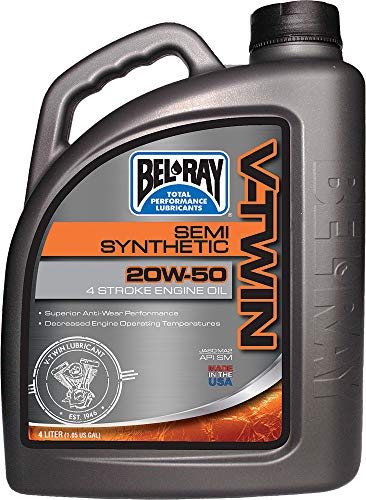
Bel-Ray’s V-Twin Semi-Synthetic Motor Oil is specifically engineered for the unique demands of large displacement V-Twin engines. These engines often produce significant heat and torque, requiring a robust lubricant that can handle the stress. The synthetic blend formulation offers a balance of performance and protection.
This multi-grade oil provides the high-temperature stability needed for air-cooled V-Twins while also ensuring easier cold starts. It is formulated to protect against wear and deposit formation, helping to maintain the health and performance of high-torque engines over the long term.
Red Line 42504 20W50 Motorcycle Oil Synthetic

Red Line’s full synthetic motorcycle oil is designed for modern Big-Twin engines, including Milwaukee-Eight, Evolution, and Twin Cam designs. It utilizes a high-performance blend of PAO and Ester base stocks, which provide superior film strength and protection for critical engine components, leading to excellent ring seal and power retention.
The formulation includes a high level of ZDDP (2200 ppm) for anti-wear protection, which is vital for flat-tappet style lifters often found in these engines. Furthermore, it uses specific friction modifiers that are compatible with wet-clutches, ensuring proper clutch operation without sacrificing engine protection.
Quicksilver 20W-50 4-Stroke Full Synthetic Motorcycle Oil

Quicksilver’s full synthetic formula is built to resist shear and oxidation, which maximizes the fluid’s service life even under demanding conditions. The excellent film strength ensures that a protective layer is maintained between metal surfaces, reducing friction and wear. Additives in the oil also protect against corrosion of internal engine components.
This oil provides comprehensive engine wear protection in high-heat conditions, making it suitable for performance use. It also offers easy starting and instant cold flow protection in low temperatures, providing year-round versatility and protection for your engine from the moment you start it.
Liqui Moly Motorbike 4T SAE 20W-50 Street

Liqui Moly’s 4T Street oil is known for its universal application and high lubricant-film stability, which translates to excellent wear protection for a wide range of motorcycles. Its high shear and ageing stability means the oil maintains its viscosity grade for longer, leading to low evaporation loss and reduced oil consumption between changes.
The oil features outstanding cleaning and dispersion properties, which are essential for preventing the formation of black sludge and deposits. This keeps engine internals clean, ensuring optimal performance and reducing the risk of blockages in oil passages that could lead to premature wear.
Castrol Actevo 4T 20W-50 Synthetic Blend Motorcycle Oil

Castrol Actevo utilizes the same Trizone technology found in their Power1 line, offering balanced protection for the engine, clutch, and gearbox. This synthetic blend provides continuous protection for both the engine and transmission, making it a dependable choice for daily riders.
It is formulated to provide excellent engine wear protection across a variety of conditions, from long highway trips and short commutes to stop-and-start city traffic. This versatility makes it a practical and effective option for riders who use their motorcycles for multiple purposes.
Mobil 1 V-Twin 20W-50 Full Synthetic Motorcycle Oil
Mobil 1 is a renowned name in synthetic lubrication, and their V-Twin specific formula is designed to meet the challenges of high-temperature, air-cooled engines. As a full synthetic, it provides superior thermal and oxidative stability compared to conventional oils, which helps prevent sludge and deposit formation.
This oil is engineered to deliver outstanding wear protection for critical engine parts like pistons, cylinders, and valvetrain components. It also offers enhanced clutch performance, ensuring smooth engagement and operation in motorcycles with integrated wet clutches. Its formulation aims to provide maximum engine cleanliness and long-term performance.
How to Choose the Best 10W-50 Racing Oils for High-Performance Engines
When I’m picking out a 10W-50 oil for my track car or high-performance street machine, I don’t just grab the first shiny bottle I see. This specific weight is a serious piece of fluid engineering, and choosing the right one means thinking about what my engine actually needs to survive and thrive under extreme conditions. The first thing I look at is the base oil composition and the additive package. Full synthetic oils are the standard here because they can handle the intense thermal stress of racing far better than conventional oils. Within synthetics, you’ll find esters and polyalphaolefins (PAOs). Esters are particularly good at sealing and cleaning, which is a huge plus for high-revving engines where every bit of power and protection counts.
Next, I consider the type of racing or performance driving I do. Is this for a dedicated track car that sees short, brutal sprint races? Or is it for a high-performance street car that also sees occasional track day use? For a pure race engine that gets frequent oil changes, I might lean towards an oil that prioritizes extreme pressure (EP) additives and robust anti-wear packages like zinc (ZDDP) and phosphorus. These components form a protective layer on metal surfaces, which is critical for flat-tappet camshafts and other high-load components. However, if the car is street-driven and has a catalytic converter, I need to be mindful that high levels of ZDDP can shorten the cat’s life. In that case, I look for a modern synthetic that offers strong protection with lower levels of these additives, or one specifically formulated for street and track use.
Another critical factor is the oil’s volatility and its resistance to thermal breakdown. During a hard session on the track, oil temperatures can easily soar past 250°F. A high-quality 10W-50 racing oil will have a high flash point and resist vaporizing or shearing down to a thinner viscosity. If the oil thins out too much, you lose critical oil pressure and film strength, which is a fast track to a spun bearing. I always check the product data sheets for things like the Noack Volatility test results and the High-Temperature/High-Shear (HTHS) viscosity rating. A higher HTHS number generally means the oil will maintain its protective thickness better under the punishing heat and mechanical shear of a racing engine.
Finally, I pay attention to brand reputation and the specific certifications or approvals an oil has. Brands that are deeply involved in motorsports often have proven products that are tested in the most demanding environments. I also look for API (American Petroleum Institute) certifications and, more importantly for European performance cars, ACEA (European Automobile Manufacturers’ Association) specifications. Some manufacturers, like Porsche or Mercedes-AMG, have their own specific approvals for certain models, and using an oil that meets that spec is non-negotiable for keeping warranties intact and ensuring optimal performance. It’s not just about picking a thick oil; it’s about picking the right 10W-50 racing oil with the correct chemistry for my engine’s specific battle.
FAQ
Can I use a 10W-50 racing oil in my daily driver?
You can, but you need to be careful. Many modern high-performance sports cars come from the factory recommending a 10W-50 or similar weight for track use. For a pure daily driver that never sees a track, a 10W-50 might be too thick for optimal cold-start protection and fuel economy. The engine is designed to work best with the manufacturer’s recommended viscosity for street conditions. However, if you have a modified engine, live in a very hot climate, or your car’s manual specifically lists 10W-50 as an option, then it’s perfectly fine. Always check your owner’s manual first.
What’s the main difference between a racing oil and a standard synthetic?
The main differences come down to the additive package and the focus. A standard street oil is formulated for long drain intervals, fuel economy, and protecting emissions equipment like catalytic converters. A true racing oil is built for one thing: maximum protection under extreme heat and stress. They often have much higher concentrations of anti-wear additives like zinc and phosphorus to protect solid lifters and high-load bearings. They also have different detergent and dispersant packages, as race engines are torn down frequently, so long-term sludge prevention is less of a priority than immediate film strength and stability.
How often should I change my 10W-50 racing oil?
This depends entirely on how you use the car. For a dedicated race car, I change the oil after every race weekend or every 4-8 hours of track time. That might seem frequent, but the oil is subjected to immense fuel dilution, moisture contamination, and the constant breakdown of its additives. For a high-performance street car that sees occasional track days, I follow a severe service schedule, changing the oil every 3,000 miles or at least twice a season, regardless of mileage. Used oil analysis is a great tool to determine the perfect change interval for your specific setup.
Is a higher zinc (ZDDP) content always better?
Not always. While ZDDP is fantastic for protecting older-style flat-tappet camshafts and high-load components, it can be a problem for modern engines. High levels of zinc can poison catalytic converters and clog diesel particulate filters (DPFs). Many modern performance engines with roller camshafts don’t need the extremely high ZDDP levels that a vintage race engine does. The key is to match the oil’s additive package to your engine’s specific requirements. More is not always better; the right amount is what matters.
Can I mix different brands of 10W-50 oil?
I avoid mixing different brands or even different product lines from the same brand if I can help it. While most modern synthetic base oils are compatible, the proprietary additive packages are not designed to be mixed. Combining them can lead to unpredictable chemical reactions that might reduce the oil’s effectiveness, cause foaming, or lead to additive dropout (where the chemicals fall out of suspension). If I’m in a real pinch and need to top off a half-quart, I’ll use the exact same brand and product. For a full oil change, I always stick with a single, fresh batch of my chosen 10W-50 racing oil.
Why is 10W-50 a common recommendation for high-performance engines?
This viscosity strikes a great balance. The “10W” refers to its flow characteristics in cold weather (Winter grade). It’s thin enough to circulate quickly on a cold start, providing critical initial lubrication to bearings and turbochargers. The “50” is its viscosity at operating temperature (around 212°F or 100°C). This is a relatively thick grade that maintains a strong lubricating film and stable oil pressure even when the oil sump temperatures are consistently above 250°F on a racetrack. This wide viscosity range makes it versatile for engines that see both street driving and intense track use.