When you’re troubleshooting an automotive electrical issue, a standard multimeter often falls short. The complex systems in modern vehicles, from sensors and alternators to fuel pumps and battery drains, demand a tool that is not only accurate but also durable and safe for the unique challenges under the hood. A reliable automotive multimeter is a non-negotiable piece of kit for any serious DIYer or professional mechanic.
Choosing the right multimeter can mean the difference between a quick diagnosis and hours of frustrating guesswork. The best models offer a blend of essential functions like voltage, current, and resistance testing, along with automotive-specific features such as temperature probes, duty-cycle measurement, and robust safety ratings. This roundup covers nine top-tier multimeters designed to deliver the precise data you need to solve electrical problems efficiently and safely.
The Best Automotive Multimeters for Your Garage
- Klein Tools MM325 Multimeter, Digital Manual-Ranging 600V AC/DC Voltage Tester
- KAIWEETS Digital Multimeter TRMS 6000 Counts Voltmeter Auto-Ranging
- Klein Tools MM420 Digital Multimeter, Auto-Ranging TRMS Multimeter
- AstroAI Digital Multimeter and Analyzer TRMS 6000 Counts Volt Meter
- Fluke 15B+ Digital Multimeter, for Electrical Applications
- Fluke 117 Digital Multimeter, Non-Contact AC Voltage Detection
- Klein Tools MM700 Multimeter, Auto Ranging, for AC/DC, LOZ, Temp
- Fluke 87V Industrial Digital Multimeter, for Advanced Troubleshooting
- AstroAI Digital Multimeter TRMS 6000 Count Volt Meter
Klein Tools MM325 Multimeter

The Klein Tools MM325 is a solid, manual-ranging multimeter built for straightforward electrical diagnostics. It covers all the fundamentals, including measuring AC/DC voltage up to 600V, testing DC current up to 10A, and checking resistance, continuity, and diodes. Its simplicity makes it an excellent choice for those who prefer to select their own measurement ranges and want a no-fuss tool for common automotive tasks like testing batteries and checking for blown fuses.
Safety and visibility are key benefits of this model. The unique Lead-Alert protection system uses LEDs to indicate proper test lead placement, which helps prevent user error and potential damage. The backlit LCD display ensures you can read measurements clearly even when working in dimly lit areas under the dashboard or in a poorly lit garage.
KAIWEETS Digital Multimeter TRMS 6000 Counts
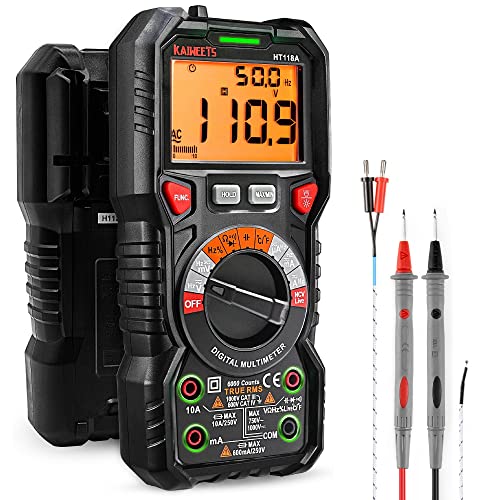
For the user seeking a high-value, feature-packed multimeter, the KAIWEETS HT118A is a standout option. Its auto-ranging capability takes the guesswork out of selecting the correct measurement scale, while the True RMS (TRMS) technology provides accurate readings even on non-linear loads. It goes beyond basic measurements to include temperature, capacitance, frequency, and duty-cycle, all of which are useful for diagnosing complex sensor and actuator issues in modern vehicles.
This model is designed with user convenience at the forefront. It includes a non-contact voltage tester with a live circuit warning, a built-in flashlight for dark engine bays, and LED-lit jacks to guide lead placement. The large, 6000-count backlit display is easy to read, and functions like Data Hold and a stable kickstand make taking and recording measurements a simple process.
Klein Tools MM420 Digital Multimeter

The Klein Tools MM420 builds upon the brand’s reputation for durability by adding auto-ranging and an expanded set of functions. This multimeter measures AC/DC current in addition to voltage and offers a high 50 MΩ resistance range. It is well-suited for automotive professionals who need to measure temperature, capacitance, and frequency/duty-cycle to troubleshoot everything from cooling fans to ignition systems and fuel injectors.
Like its manual-ranging sibling, the MM420 incorporates the valuable Lead-Alert protection and a backlit display for safe and visible operation. The combination of advanced measurement capabilities with these user-focused safety features makes it a reliable and efficient tool for a wide spectrum of electrical testing scenarios in the shop.
AstroAI Digital Multimeter and Analyzer

The AstroAI Digital Multimeter and Analyzer is a versatile TRMS meter that provides excellent functionality for its category. It accurately measures a comprehensive list of parameters including AC/DC current, voltage, capacitance, frequency, duty cycle, and temperature. This makes it a capable partner for diagnosing a wide array of automotive electrical problems, from a faulty battery to a malfunctioning sensor.
Thoughtful design elements enhance the user experience. It features a large LCD backlit screen, a data hold function to freeze readings, and a convenient kickstand for hands-free operation. With its auto-ranging capability and True RMS accuracy, this multimeter offers a professional level of performance that is suitable for both DIY projects and professional use.
Fluke 15B+ Digital Multimeter

Fluke is a renowned name in the electrical test equipment industry, and the 15B+ embodies the brand’s commitment to reliability and safety. This multimeter is designed for general electrical applications, with the robust construction and accuracy needed for automotive diagnostics. It measures AC/DC voltage up to 1000V and current up to 10A, along with resistance, continuity, diode, and capacitance.
A key feature of the 15B+ is its CAT III 600V safety rating, which certifies it for use on electrical systems commonly found in residential and commercial settings, including automotive applications. This rating provides peace of mind, knowing the tool is built to withstand voltage spikes and protect the user. Its straightforward interface and trusted performance make it a go-to for technicians who depend on their tools daily.
Fluke 117 Digital Multimeter

The Fluke 117 is a premium multimeter designed for electricians, but its features are exceptionally beneficial for automotive professionals. Its most notable feature is the integrated non-contact voltage detection (VoltAlert), allowing you to quickly and safely check for the presence of AC voltage without touching electrical conductors. This is a great first step before beginning detailed testing.
Beyond this, the 117 includes AutoVolt for automatic AC/DC voltage selection and a low impedance (LoZ) mode. This mode is crucial for automotive work as it helps prevent false readings caused by “ghost voltage”—stray voltage induced in wiring that can lead to incorrect diagnoses. Its ability to measure frequency and capacitance further solidifies its position as a top-tier diagnostic tool.
Klein Tools MM700 Multimeter

The Klein Tools MM700 is a high-performance, auto-ranging True RMS multimeter built for demanding environments. It can measure up to 1000V AC/DC and includes a comprehensive suite of functions such as temperature, capacitance, frequency, duty-cycle, and a low impedance mode to squash ghost voltages. This makes it an incredibly powerful tool for advanced automotive diagnostics.
Safety is a paramount feature of the MM700, which boasts a CAT IV 600V safety rating. This is the highest level of protection for overvoltage category IV, meaning it is rated for use on the primary electrical supply, such as the service entrance. This robust safety rating provides maximum protection for the user, making it suitable for the most challenging electrical troubleshooting tasks.
Fluke 87V Industrial Digital Multimeter

The Fluke 87V is widely regarded as the gold standard for industrial and automotive diagnostic multimeters. It is engineered for advanced troubleshooting, with features that are specifically beneficial for automotive technicians. Its low-pass filter allows for accurate frequency and voltage measurements on variable-frequency drives and ignition systems, filtering out the electrical noise that can throw off other meters.
This multimeter excels at capturing intermittent electrical faults. The Peak Capture function records transients as fast as 250 microseconds, helping you find those elusive glitches that cause random stalling or electronic control module (ECM) resets. With its high safety rating (CAT III 1000V / CAT IV 600V) and exceptional accuracy, the 87V is the tool of choice for professionals who cannot afford compromise.
AstroAI Digital Multimeter TRMS 6000 Count
This AstroAI TRMS 6000 Count multimeter is a general-purpose model that offers reliable performance for a variety of electrical testing needs. As a True RMS meter, it provides accurate measurements of AC current and voltage, which is essential for diagnosing modern automotive systems with non-sinusoidal waveforms. It is designed to measure voltage, current, resistance, and other common electrical parameters.
This model is built with the user in mind, featuring a clear digital display and standard safety functions. It represents a solid value for hobbyists and DIYers who need a dependable multimeter for basic to intermediate automotive electrical work, from checking battery health to testing circuits and components.
Buying Guide: How to Choose the Right Automotive Multimeter
When I’m picking out a tool for my garage, I need to know it’s going to work when I need it most. A multimeter is no different. For automotive work, you can’t just grab any meter from the electronics bin; you need one built to handle the unique challenges of a car’s electrical system. The first thing I always check is the category rating. Look for a meter rated CAT III or higher. This isn’t just a fancy acronym; it means the meter is designed to handle the high-energy transient voltages found in automotive and other electrical systems, which is a critical safety feature. A cheap meter without this rating could literally explode in your hands if you probe the wrong circuit.
Next up, I look at the functions. At a minimum, you need to measure DC voltage, DC current (amps), and resistance. For automotive work, a few specific features are game-changers. One is a duty cycle function, which is essential for testing fuel injectors and some sensors. Another is a frequency function for checking crank and cam position sensors. And let’s not forget a good temperature probe with a thermocouple – it’s incredibly useful for diagnosing cooling system issues or checking catalytic converter operation. A continuity test with a loud audible beeper is also a must-have; when my hands are full, I need to hear that beep without looking at the screen.
Accuracy and display are also huge for me. I want a meter with a high enough count display to give me precise readings. A 3.5-digit display (1999 count) is pretty standard, but a 4.5-digit (19999 count) is even better for seeing small voltage drops. The build quality needs to be tough. I’m not gentle with my tools, so a robust, drop-proof casing and well-protected input jacks are non-negotiable. Finally, I consider the brand’s reputation and the availability of accessories like alligator clip leads, which are a lifesaver for making hands-free connections. Getting the right tool makes all the difference, and for anyone serious about car repairs, investing in one of the 9 best automotive multimeters for accurate electrical testing is a smart move that pays for itself quickly.
FAQ
What is the difference between an automotive multimeter and a standard one?
While a standard multimeter can measure basic electrical values, an automotive multimeter is specifically designed for the harsh electrical environment of a vehicle. It often includes features like temperature measurement with a probe, duty cycle, and frequency reading, which are essential for diagnosing sensors, fuel injectors, and ignition systems. They are also built to a higher safety standard (like CAT III) to protect against voltage spikes common in a car’s 12V system that could damage a standard meter.
Can I use a multimeter to test a car battery?
Absolutely. This is one of the most common and useful tasks. Set your multimeter to DC Volts (usually a “V” with a straight line). A healthy, fully charged car battery should read around 12.6 volts when the engine is off. With the engine running, the alternator should be charging, and you should see a voltage between 13.7 and 14.7 volts. If it’s lower, you likely have a charging system problem.
How do I check a fuse with a multimeter?
Checking a fuse is simple and a great way to learn. Set your multimeter to the resistance (Ohms Ω) or continuity setting (which usually has a speaker symbol). Remove the fuse from the vehicle. Touch one probe to each of the metal ends on the fuse. If the fuse is good, you will hear a continuous beep (in continuity mode) or see a resistance reading very close to zero Ohms. If the fuse is blown, the meter will not beep and will show “OL” or infinite resistance, meaning the circuit is open.
Is it safe for a beginner to use a multimeter on a car?
Yes, if you follow basic safety precautions. Always start with the engine off and the key out of the ignition. Be very careful when probing around moving parts like fans and belts. When measuring current (amps), you must plug the red lead into the correct, often separate, socket on the meter and break the circuit, which is more advanced. For most beginners, I recommend sticking to voltage and resistance tests, which are done in parallel with the circuit and are much safer. Reading the manual that comes with your device is the best first step to ensure you are using one of the 9 best automotive multimeters for accurate electrical testing correctly and safely.
What does “OL” mean on my multimeter display?
“OL” stands for “Overload” or “Open Loop.” It essentially means the resistance is so high that your meter can’t measure it. In practical terms, when you’re testing for continuity (like with a fuse or a wire), “OL” means the circuit is broken or open—there is no complete path for electricity to flow. So, if you’re testing a wire and see “OL,” it means there’s a break in the wire somewhere.