In today’s digitally dependent world, a sudden power outage is more than an inconvenience; it can mean lost work, interrupted communication, and potential hardware damage. For critical electronics like computers, networking equipment, and home office setups, a reliable battery backup (UPS) is an essential layer of protection. These devices provide a crucial bridge, giving you time to save your progress and shut down your equipment properly during a blackout.
Beyond emergency battery power, a quality UPS also offers superior surge protection, safeguarding your investments from voltage spikes that can occur during storms or when power is restored. The right unit for you depends on your specific needs, from a simple desktop setup to a full home office or entertainment system. This roundup highlights eight of the best options available to ensure your critical devices stay powered and protected.
Our Recommended Battery Backup UPS Units
- APC UPS Battery Backup and Surge Protector, 600VA
- APC Back-UPS Pro 1500VA UPS Battery Backup
- APC UPS Battery Backup Surge Protector, 425VA
- GOLDENMATE 1000VA/600W Lithium UPS Battery Backup
- GOLDENMATE 1000VA/800W Lithium UPS Battery Backup
- APC Back-UPS Pro 1500VA UPS (BR1500MS2)
- CyberPower CP1500PFCLCD PFC Sinewave UPS System
- Tripp Lite SMART1500LCDT UPS System, 1500VA/900W
APC UPS Battery Backup and Surge Protector, 600VA
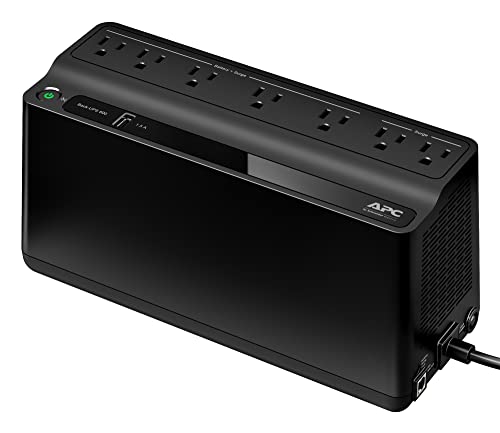
For basic but essential protection of your home office or entertainment center, the APC BE600M1 is a reliable and compact choice. This 600VA/330W unit provides sufficient battery backup power for devices like a computer, monitor, and Wi-Fi router, giving you enough time to save your work and shut down safely during an outage. Its seven outlets are thoughtfully divided, with five offering both battery backup and surge protection and two providing surge protection only for peripherals like printers.
The inclusion of a 1.5A USB charger port adds convenience for topping up smartphones or tablets. As a product from APC, a leader in power protection, you benefit from a trusted brand known for its durability and performance. This model strikes an excellent balance between essential features and an accessible design, making it a perfect entry-point for critical power protection.
APC Back-UPS Pro 1500VA UPS Battery Backup

When you need to protect a more substantial setup, such as a PC with multiple monitors, a NAS device, and a networking station, the APC BX1500M delivers the necessary runtime and outlet capacity. With 1500VA/900W of power, this unit can support high-power devices for a longer duration, minimizing disruptions. It features ten outlets, with half providing battery backup and the other half offering dedicated surge protection, allowing for organized cable management.
A significant advantage of this Pro series model is the inclusion of a dedicated data port for network dataline protection, safeguarding your connected equipment from surges traveling over Ethernet cables. For users who want advanced control, it is compatible with APC’s PowerChute management software for graceful, automated system shutdowns. This UPS is built for demanding home office and enthusiast computing environments.
APC UPS Battery Backup Surge Protector, 425VA

The APC BE425M is an ideal, space-saving solution for protecting essential but lower-power devices. With a 425VA/225W rating, it is perfectly suited for equipment like routers, modems, VoIP phones, and security system controllers. These are devices that need to stay online during short power interruptions to maintain your internet and communication links. The unit offers six outlets, with four on battery backup and two for surge-only protection.
Its compact form factor and wall-mountable design make it easy to install in tight spaces, such as a network closet or behind entertainment furniture. It is important to note that the battery in this model is service-replaceable by a technician, not user-replaceable, which is a key consideration for long-term maintenance. For basic, reliable protection of your most critical connectivity gear, this UPS is a solid performer.
GOLDENMATE 1000VA/600W Lithium UPS Battery Backup

GOLDENMATE brings modern lithium technology to the UPS market with this 1000VA/600W model. The core advantage lies in its LiFePO4 (Lithium Iron Phosphate) battery, which offers a remarkable lifespan of over 10 years and 5000+ charge cycles. This can significantly reduce the total cost of ownership compared to traditional lead-acid UPS units that require battery replacements every 3-5 years. The pure sine wave output ensures compatibility with sensitive electronics, including active PFC power supplies found in modern computers.
This unit features eight outlets with surge protection and an informative LCD display that provides real-time status updates on load, voltage, and battery level. A built-in Battery Management System (BMS) and an efficient cooling fan ensure safe and reliable operation. For those looking for a long-term, maintenance-friendly power solution, this lithium-based UPS is a compelling option.
GOLDENMATE 1000VA/800W Lithium UPS Battery Backup

As a more powerful sibling to the 600W model, this GOLDENMATE 1000VA/800W UPS shares the same advanced LiFePO4 battery technology, promising the same decade-long lifespan and cost savings. The higher 800W wattage rating means it can support more powerful devices or the same number of devices for a longer runtime. This makes it suitable for protecting high-end workstations, servers, or extensive network setups that demand more robust backup power.
It includes all the premium features of the 600W version, including the pure sine wave output, eight protected outlets, LCD display, and advanced BMS for safety. The upgraded cooling system operates quietly under normal conditions, only activating when needed during heavy battery use. If your power protection needs are on the higher end but you still value the long-term benefits of lithium technology, this is an excellent choice.
APC Back-UPS Pro 1500VA UPS (BR1500MS2)
The APC BR1500MS2 is a feature-rich tower model designed for users who require detailed power management and maximum protection. Like the BX1500M, it offers 1500VA of backup power, but it often includes an LCD screen that provides clear, immediate feedback on load capacity, runtime, and event history. This display allows for at-a-glance monitoring of your power health and the status of the UPS battery.
This unit typically includes a comprehensive suite of power management features, such as automatic voltage regulation (AVR) which corrects minor power fluctuations without using the battery, thereby extending its life. It also offers multiple data line protection ports for both coaxial and Ethernet cables. For professionals and power users who want granular insight and control over their power environment, the BR1500MS2 is a top-tier selection from a trusted brand.
CyberPower CP1500PFCLCD PFC Sinewave UPS System
The CyberPower CP1500PFCLCD is a standout unit for users with high-wattage components, such as gaming PCs or professional workstations with advanced power supplies. It delivers 1500VA/1000W of pure sine wave power, which is essential for the stable operation of Active PFC power supplies. Without a pure sine wave, these modern PSUs may shut down or malfunction when running on battery power.
This model comes equipped with an LCD interface that displays detailed diagnostics and allows for easy configuration. It also features automatic voltage regulation (AVR) to handle brownouts and overvoltages efficiently. With multiple battery-backed and surge-protected outlets, it provides ample connectivity for a complete system. For anyone with sensitive, high-performance computing equipment, this CyberPower UPS offers the precise and clean power required for reliable protection.
Tripp Lite SMART1500LCDT UPS System
Tripp Lite is another respected name in power protection, and the SMART1500LCDT exemplifies its commitment to reliability and user-friendly design. This 1500VA/900W tower UPS provides ample power for a wide range of home and office applications. Its key feature is the multi-function LCD display, which offers a clear readout of status, output wattage, and estimated runtime, putting essential information at your fingertips.
The unit includes AVR technology to boost or buck incoming voltage to safe levels, ensuring your connected equipment receives clean, stable power and conserving battery life for actual outages. It also comes with PowerAlert management software for automatic safe shutdown of connected systems. Built with a robust design and backed by a strong warranty, the Tripp Lite SMART1500LCDT is a dependable workhorse for ensuring continuous, clean power.
Buying Guide: How to Choose the Best Battery Backup UPS
When my computer screen flickers during a storm, I’m immediately grateful for my uninterruptible power supply, or UPS. This isn’t just a fancy power strip; it’s my first line of defense against data loss and hardware damage. If you’re looking for one, the most important step is figuring out what you need it to do. Let’s break down the key factors I always consider.
First, you need to understand the types of UPS. A Standby UPS is the most basic and affordable. It stays idle until it detects a power failure, then switches to battery power. This switch takes a few milliseconds, which is fine for home computers and entertainment systems. Line-Interactive UPS units are the sweet spot for most people. They have a feature that automatically corrects minor voltage sags and surges without draining the battery, which is great for areas with frequent brownouts. For truly critical equipment like servers or high-end workstations, an Online Double-Conversion UPS is the gold standard. It constantly powers your gear from its battery, providing a perfect, clean electrical sine wave and zero transfer time during an outage.
Next, let’s talk about capacity, which is measured in Volt-Amps (VA) and Watts. This is where many people get tripped up. VA is the “apparent power,” while Watts is the “real power” your devices actually consume. You need a UPS that can handle both. To find the right size, add up the wattage of all the equipment you plan to plug in and then add a 20-25% buffer for future expansion. A 1500VA/900W model can typically run a desktop computer, monitor, and a small network setup for enough time to safely shut everything down.
Runtime is another crucial spec. It tells you how long the UPS will power your connected devices once the electricity goes out. A higher VA/Watt rating usually means a longer runtime, but this also depends on the battery’s health and the load you’re putting on it. Think about what you need to accomplish during an outage. Is it just a three-minute grace period to save your work and shut down? Or do you need to keep a network running for an hour? Most manufacturers provide runtime charts for different loads.
Don’t overlook the outlets! Check how many outlets are battery-backed and how many are just surge-protected. Many UPS models also include outlets that are controlled by management software, allowing for remote reboot. The display panel is your window into the UPS’s status, showing information like load capacity, battery health, and remaining runtime. A simple display with indicator lights might be sufficient, but an LCD screen provides much more detailed information. Finally, consider the software. Many UPS systems come with a USB or network connection cable and software that can automatically save your open files and safely shut down your operating system when you’re not around, which is a lifesaver for servers or media centers.
Frequently Asked Questions
What’s the actual difference between a UPS and a surge protector?
A surge protector is a passive device. Its only job is to block sudden voltage spikes from reaching your electronics, like a shield. A battery backup UPS, however, is an active device. It does include surge protection, but its primary function is to provide immediate battery power when your main electricity fails. This gives you time to work through short outages or perform a graceful shutdown during a long one, protecting both your hardware and your data. Think of a surge protector as a helmet and a UPS as the entire safety harness.
How long does a typical UPS battery last?
This is one of the most common questions I get. The sealed lead-acid batteries used in most consumer and prosumer UPS units have a finite lifespan, typically between 2 to 5 years. Their life is shortened by factors like high ambient temperature, frequent power cycles, and how often they are called upon to provide backup power. Most UPS systems have a self-test feature and will alert you with a warning light or beep when the battery needs to be replaced. It’s not a question of if you’ll need to replace it, but when.
Can I plug a printer or laser copier into my UPS?
I strongly advise against it. Printers, especially laser printers, and copiers have high power demands when they heat up their fusers. This sudden surge can overload the UPS, causing it to shut down or potentially damaging its components. These devices don’t need a graceful shutdown like a computer, so it’s best to plug them directly into a wall outlet or a dedicated surge protector instead of your valuable battery backup.
Why does my new UPS beep when there isn’t a power outage?
That beeping is its way of talking to you! If the power is on and it’s beeping, it’s usually signaling a different issue. Common reasons include an overload (you’ve plugged in too many devices), a failing battery that needs replacement, or the unit detecting poor power quality from your wall outlet, like frequent voltage sags. Check the manual or the unit’s display for a specific error code to diagnose the exact cause.
Is it worth investing in a more expensive Online UPS for my home office?
For most home office setups with a standard desktop computer, a line-interactive UPS is perfectly adequate and more cost-effective. An Online Double-Conversion UPS is overkill unless you have extremely sensitive or mission-critical equipment that cannot tolerate even a millisecond of power transfer time or requires absolutely pristine power quality. The added cost, noise, and heat generation of an Online UPS are usually unnecessary for typical home use.
What should I do to maintain my UPS?
Maintenance is pretty straightforward. Keep the unit in a cool, dry place away from direct sunlight, as heat is a battery’s worst enemy. Ensure the vents are not blocked so it can cool itself properly. Run the self-test function every few months (most have a button for this). Most importantly, pay attention to the status indicators and replace the battery promptly when the unit tells you to. This ensures your 8 best battery backup UPS for critical power protection system is always ready when you need it most.